Rising Stars Under 25 in the NBA: Young Players Poised for Breakout Seasons
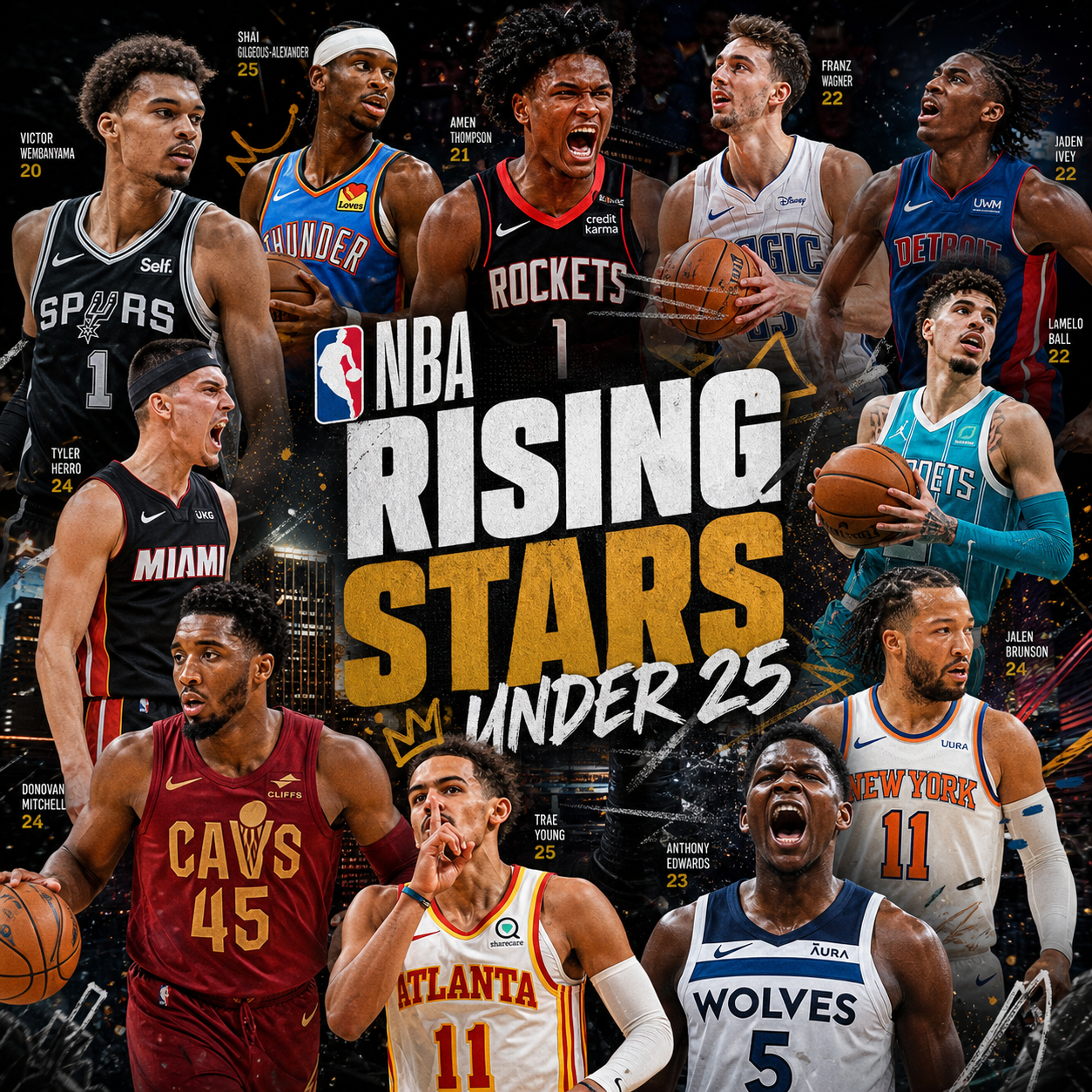
The NBA’s next generation is already changing how winning basketball is played. Young creators are handling the ball earlier, centers are passing from the elbow, and two-way wings are taking on the toughest defensive assignments before their 25th birthdays.
Evaluating these players requires more than checking points per game. Team role, efficiency, availability, playmaking responsibility, defensive reliability, and development runway all matter. The strongest candidates combine present impact with skills that should remain valuable when playoff defenses become more aggressive.
How to Evaluate the NBA’s Rising Stars
NBA rising stars under 25 should be judged by current impact, efficiency, two-way value, consistency, and realistic long-term upside. Age creates development potential, but it does not excuse poor decision-making or inefficient production.
A useful framework is the Impact-Upside Test. First, measure what a player contributes today. Then ask whether his skill set can expand without undermining team balance.
- Production: Scoring, rebounding, assists, stocks, and on-court influence relative to role.
- Efficiency: True shooting, shot quality, turnover rate, finishing, and three-point accuracy.
- Responsibility: Usage, pick-and-roll creation, defensive assignments, and late-game touches.
- Portability: Whether the player helps different lineups and playoff schemes.
- Development runway: Age, rookie or sophomore progression, physical tools, and room to improve.
Advanced metrics can sharpen the picture, but they need context. A high-usage guard on a rebuilding team faces different demands from a low-usage wing on a contender. On-off numbers, lineup data, assist-to-turnover ratio, shot profile, and defensive matchup difficulty should support film study rather than replace it.
The Young Players Already Making a Major Impact
Victor Wembanyama, Anthony Edwards, Paolo Banchero, and Tyrese Haliburton represent the clearest group of under-25 players already operating near franchise-cornerstone status. Their teams rely on them for more than isolated scoring.
Victor Wembanyama
Wembanyama’s combination of rim protection, handle, shooting touch, and passing gives San Antonio a foundation few young players in NBA history have offered. His length changes opponents’ shot selection even when he does not record a block. Offensively, the next step is improving strength, screening angles, and decision-making against physical switches.
Anthony Edwards
Edwards has developed from explosive scorer into a primary perimeter creator who can attack closeouts, absorb playoff pressure, and defend with force. His pull-up shooting opens driving lanes, while his late-game confidence gives Minnesota a reliable closer. Better shot selection and more consistent playmaking would make his offense harder to scheme against.
Paolo Banchero
Banchero’s size and ball skills allow him to initiate offense from the wing, post, and elbow. Orlando benefits when he uses his physical advantage to create rotations rather than settling for difficult jumpers. His future All-Star case depends on efficiency, defensive concentration, and a lower turnover burden as the Magic add more high-level creators.
Tyrese Haliburton
Haliburton’s value comes from manipulating defenses before they can recover. His pace, passing angles, pull-up threat, and transition vision turn ordinary actions into high-value possessions. The concern is defensive physicality and the need to remain effective when opponents deny his first pass or force him into isolation.
Guards and Wings With Star-Level Potential
Emerging guards and wings earn star-level projections when scoring gravity, playmaking, shooting, and defensive responsibility develop together. This group includes established young stars and players still proving that their best stretches can become a full-season baseline.
Jalen Williams and Cade Cunningham
Jalen Williams offers Oklahoma City efficient secondary creation, intelligent cutting, positional size, and improving defensive versatility. His ability to attack a tilted defense makes him particularly valuable beside a dominant lead guard. Greater three-point volume would force defenders to respect him farther from the rim.
Cunningham has the physical profile and passing ambition of a lead initiator. Detroit needs him to convert more efficiently at the rim, limit live-ball turnovers, and defend with sustained effort. If those areas stabilize, his pick-and-roll scoring and playmaking could support a first-time All-Star leap.
Jalen Brunson’s young challengers
Players such as LaMelo Ball, Scottie Barnes, and Brandon Miller illustrate different routes to stardom. Ball creates difficult shots and high-level passes but must prove durability and defensive dependability. Barnes brings size, rebounding, connective passing, and defensive versatility; his half-court scoring has to become more reliable. Miller’s shooting, movement, and composure give him a strong foundation, while stronger rim pressure would broaden his offensive profile.
Other guards, including Tyrese Maxey and Coby White, show how shooting improvement can transform team role. Maxey’s speed and pull-up range make him a dangerous lead scorer, while White’s spacing and decision-making have increased his value as a two-way backcourt piece. Their next challenge is maintaining efficiency when defenses build entire game plans around them.
Big Men Reshaping the Next Generation
The best young big men combine interior scoring with passing, spacing, mobility, or defensive versatility. Modern centers must influence possessions beyond post-ups, while forwards increasingly function as decision-makers.
Wembanyama leads the conversation, but Chet Holmgren shows another model. His shooting, timing as a help defender, and ability to finish above the rim create efficient offense around Oklahoma City’s guards. Physicality and rebounding consistency remain important tests, especially against larger frontcourts.
Bam Adebayo is older than this article’s main group, so younger comparisons should focus on players such as Evan Mobley, Alperen Sengun, and Jalen Duren. Mobley’s switching, rim protection, and passing can anchor a defense, although a dependable jumper would make his offensive fit more flexible.
Sengun is a skilled offensive hub with soft touch, inventive passing, and strong post footwork. His defensive positioning and screen navigation determine whether his offensive brilliance translates into deep playoff minutes. Duren provides vertical spacing, offensive rebounding, and interior finishing; expanding his passing and defensive awareness would raise his ceiling.
The trade-off is clear: a scoring center can carry regular-season offense, but a franchise cornerstone must also survive targeted playoff attacks. Defensive adaptability and decision-making often separate promising production from sustainable impact.
Breakout Candidates to Watch
Breakout candidates are young players positioned for a major jump because their role, skill package, or consistency is ready to expand. The best targets are not always the players with the loudest highlights; they are often one improvement away from unlocking more possessions.
- Jaden Ivey: His speed and downhill pressure can change Detroit’s offense if his shooting decisions and defensive discipline improve.
- Keyonte George: Utah’s young guard has the handle and confidence to create shots, but efficiency and playmaking reads will determine his long-term role.
- Amen Thompson: Elite athleticism, rebounding, and defensive instincts give him immediate two-way value. A reliable jumper would dramatically expand his offensive usefulness.
- Ausar Thompson: His defensive range and transition impact are intriguing. Half-court shooting and ball security remain essential development priorities.
- Shaedon Sharpe: Explosive finishing and shot-making provide a foundation, while consistency, playmaking, and defensive engagement could determine whether he becomes a featured option.
Expanded usage creates opportunity, but it also exposes weaknesses. A young player promoted from 18 percent usage to 25 percent usage must create more efficiently, read help defenders faster, and avoid allowing extra touches to become extra turnovers.
What Separates a Rising Star From a Future Superstar?
A future superstar sustains efficiency, decision-making, defensive reliability, availability, and playoff translation as responsibility increases. Potential becomes more credible when a player’s strengths survive tougher opponents and changing team contexts.
Watch for five indicators:
- Pressure-proof creation: Can the player generate a good shot after the first action fails?
- Efficient volume: Does increased usage preserve true-shooting efficiency and limit forced attempts?
- Defensive trust: Can coaches keep him on the floor against elite opponents?
- Fast processing: Does he punish traps, rotations, and switches with the correct pass?
- Availability: Can he deliver across a long regular season and postseason without assuming perfect health?
One common mistake is treating scoring average as a complete ranking system. Another is projecting improvement in every area at once. Development usually has an order: a player may first improve his handle, then his passing reads, then his efficiency under heavier defensive attention.
Playoff translation matters because postseason basketball removes easy opportunities. Transition chances decline, matchups repeat, and opponents target weak defenders. A rising star who can shoot, pass, defend, and make quick decisions has a much stronger chance of becoming a franchise cornerstone.
Ranking the Best Long-Term Bets
The strongest long-term bets are Wembanyama, Edwards, Banchero, Haliburton, Holmgren, and Williams, with Sengun, Barnes, Cunningham, and Miller forming a compelling next tier. This assessment weighs present ability, development runway, team situation, and ceiling rather than popularity or points per game alone.
Tier 1: Franchise-level trajectories
- Victor Wembanyama: Rare defensive impact with an expanding offensive toolkit and enormous development runway.
- Anthony Edwards: Primary scoring, physical defense, and proven late-game responsibility.
- Paolo Banchero: Big initiator whose creation burden and efficiency can grow with Orlando’s roster.
- Tyrese Haliburton: An elite offensive organizer whose shooting and passing raise team-wide efficiency.
Tier 2: High-end All-Star potential
- Chet Holmgren: A two-way big whose spacing and rim protection fit modern playoff basketball.
- Jalen Williams: Efficient, versatile creation within a winning team structure.
- Alperen Sengun: Offensive hub with unusual passing creativity, balanced by defensive questions.
- Scottie Barnes and Evan Mobley: Defensive versatility and connective playmaking provide high floors, with shooting development setting the ceiling.
Tier 3: Breakout-dependent bets
Cunningham, Miller, Maxey, Thompson, Ivey, George, and Sharpe remain difficult to order because their future value depends heavily on role and consistency. A player on a rebuilding team may post larger numbers, while a young contributor on a contender may show fewer statistics but stronger winning habits.
The fairest comparison asks a simple question: what does this player already do that helps a good team win, and what single improvement would most expand his role? That question keeps evaluation grounded while leaving room for genuine upside.
Frequently Asked Questions
Which NBA players under 25 have the highest upside?
Wembanyama, Edwards, Banchero, Holmgren, Haliburton, and Williams stand out because they already affect winning while retaining meaningful room for growth. Their ceilings differ by role, but each has a skill that can anchor an offense or defense.
What makes a young NBA player a rising star?
A rising star combines increasing responsibility with efficient production and visible improvement. Strong indicators include reliable decision-making, two-way impact, lineup flexibility, and performance against quality opponents.
Which under-25 players could become first-time All-Stars?
Cunningham, Miller, Barnes, Mobley, Sengun, Maxey, and several Thompson brothers have plausible paths. Their cases depend on health, expanded team roles, efficiency, and whether their defensive impact matches their offensive growth.
How should young players be compared across different positions?
Compare them by role-adjusted impact rather than raw statistics. A center’s rim protection and screening, a guard’s creation, and a wing’s defensive versatility should be assessed through efficiency, usage, lineup value, and playoff portability.